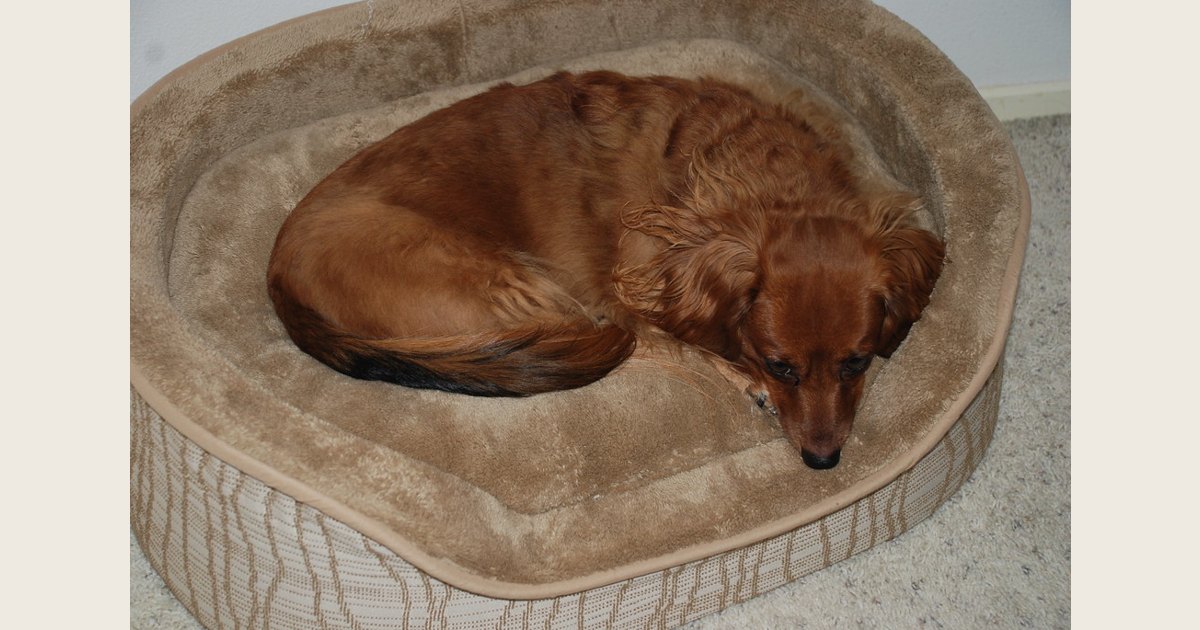
A memory foam dog bed can be worthwhile when it gives your dog room to sleep naturally, cushions them without bottoming out, and is easy to clean. The thickest bed or boldest “orthopedic” label is not automatically best. Start with how your dog sleeps, then compare usable surface, foam construction, entry height, and cover—not just outside dimensions or marketing copy.
Photo: Molly the Dachshund Loves her Dog Bed by Howard O. Young, https://www.flickr.com/photos/16947083@N06/4245405188; https://creativecommons.org/licenses/by/2.0/. Resized and padded. Illustrative stock photo; it shows a dog on a bed but does not establish the foam composition or imply product testing.
Key takeaways
- Pick the bed around the way your dog actually sleeps. Measure them while they are relaxed and stretched or curled up, then compare that measurement with the sleep surface, not the product’s overall footprint.
- Look for a supportive foam core, a removable washable cover, a stable base, and an entry height your dog can manage comfortably.
- “Orthopedic” is a product description, not a medical result. A bed can be one part of a comfortable home setup, but it does not diagnose or treat joint disease.
- If a dog has new, worsening, or persistent trouble rising, walking, using stairs, or jumping, arrange a veterinary assessment rather than trying to solve the problem with a new bed alone.
What a memory foam dog bed does—and does not—tell you
Memory foam is a pressure-responsive foam used in many pet beds. It can be comfortable, but the words memory foam do not reveal how thick the core is, whether it is a single solid piece or a mixed fill, how much conventional support foam is underneath it, or whether the bed will suit your dog’s preferred position.
Beds with the same label can still differ. A sprawler may need an open, roomy surface; a curler may prefer an edge to lean against. Bolsters can reduce flat sleep space, and a deep, soft bed may be harder for some dogs to enter or leave.
Treat “orthopedic” as a cue to inspect construction, not proof of a health benefit. Once your dog settles, the bed should still keep them off the hard floor. If their hips, shoulders, or elbows plainly reach the floor through the cushion, it is not providing enough padding for that dog.
1. Get size and sleep position right first
Observe your dog for a few naps before shopping. Do they stretch flat, curl tightly, lean into furniture, burrow, or switch positions repeatedly? The answer determines whether a flat mattress-style bed, a bolster bed, or a more enclosed shape is likely to be useful.
For sizing, measure from the nose to the base of the tail while your dog is in their typical sleeping position. CertiPUR-US suggests adding 8 to 10 inches or moving up to the next size for comfort in its dog-bed buying guide. That is a helpful starting point, but use the listing’s actual interior or sleep-surface dimensions whenever they are available.
A few fit checks make comparison easier:
- A sprawler needs enough clear surface to extend without hanging over the edge.
- A curler may enjoy a smaller-feeling nest, but should still be able to change position easily.
- A dog that rests their head on the sofa arm may appreciate a bolster; check that the bolster does not take away too much flat sleeping room.
- For a crate bed, measure the crate’s inside floor and leave room for the door to close without crushing the bed.
Brand size labels are not consistent. Compare inches, then account for your dog’s body shape and likely growth if they are still young.
2. Compare the foam core, not just the bed’s height
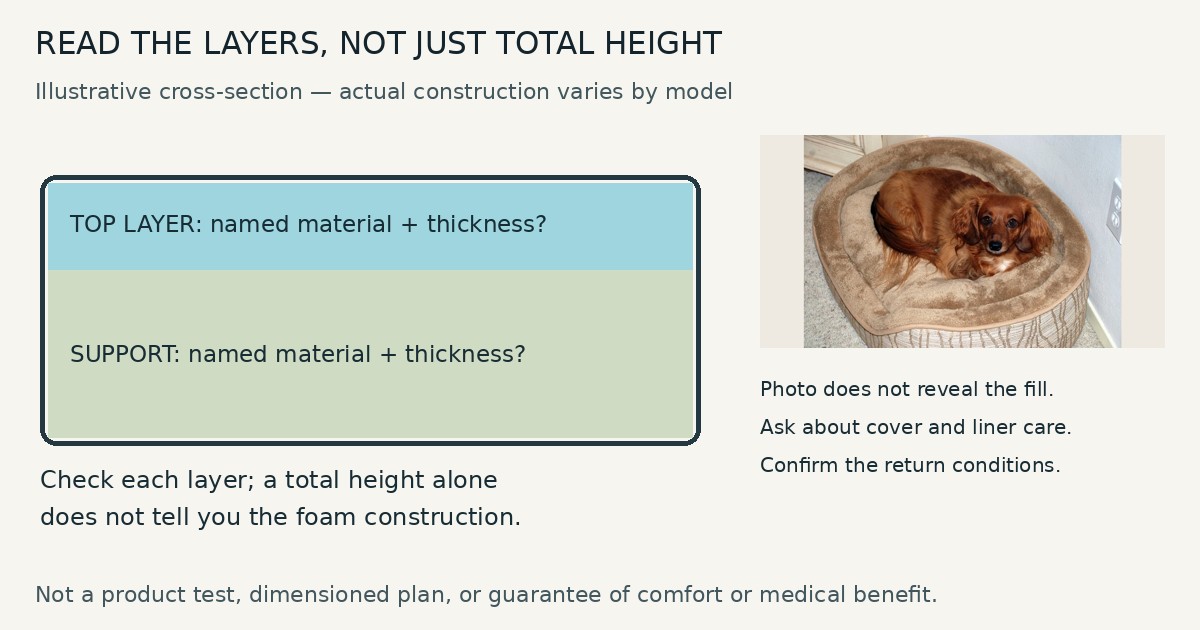
Layer diagram and annotations: Pet Gear Journal. Photo: Molly’s Dog Bed by Howard O. Young, https://www.flickr.com/photos/16947083@N06/4245418764; https://creativecommons.org/licenses/by/2.0/. Photograph resized and combined with original annotations. Illustrative cross-section, not the pictured bed’s verified construction or a product test.
Compare the stated material and thickness of each foam layer, not just total bed height. “Memory foam over support foam” is more informative than “plush” or “orthopedic,” while a single solid core is another construction description—not proof of better or worse support. No universal thickness suits every dog. Layer names and measurements do not establish firmness, density, durability, or feel in use. If the listing omits details, mark them unknown rather than treating height or marketing labels as proof. Check that the sleep surface and entry suit your dog, and read the return terms: can it be returned after opening, by when, and with what fees or hygiene exclusions? Without a usable return option, comfort remains uncertain until purchase.
3. Consider entry height and placement for older dogs
For an older or stiff dog, easy entry may matter more than a tall, deeply cushioned bed. A low front edge, open side, or flat mattress can help. Place the bed on a level, stable surface outside busy pathways so your dog can rest undisturbed.
A comfortable bed is not a substitute for veterinary care. Cornell lists stiffness, lameness or gait changes, reluctance to walk or exercise, difficulty with stairs or jumping, and difficulty getting up from lying down among possible signs of canine osteoarthritis. Its guidance also describes veterinary examination and, when appropriate, imaging as part of diagnosis. See the Cornell University College of Veterinary Medicine’s osteoarthritis overview for the full context.
If those signs are new, worsening, or persistent, contact your veterinarian. A bed may make a resting spot more comfortable, but it cannot establish the cause of pain or mobility changes.
4. Make washable covers a non-negotiable feature
A washable cover is often more valuable over time than a decorative fabric or a built-in pillow. Mud, loose hair, accidents, and everyday odor are easier to manage when the cover can come off and go through the wash according to its label. CertiPUR-US likewise recommends choosing a machine-washable bed or removable machine-washable cover in its dog-bed guide.
Before buying, check four details:
- Removal: Is there a full zipper opening, and can you remove the cover without wrestling the foam through a tiny gap?
- Care instructions: Is the cover machine-washable, and are there drying limits that will be realistic in your home?
- Inner protection: Does the bed have a separate liner or water-resistant barrier around the foam? If so, check whether it is removable and cleanable.
- Replacement availability: A replaceable cover can extend the practical life of a sound foam core.
Water-resistant does not mean indestructible, and a washable cover does not mean every component can be machine-washed. Follow the manufacturer’s instructions so the cover, liner, and foam keep their intended shape.
5. Read material and certification claims precisely
If indoor-air-quality considerations matter to you, look for specific information rather than a vague “non-toxic” claim. CertiPUR-US describes its program as certification of flexible polyurethane foam for use in furniture and bedding in its technical guidelines. Treat a “CertiPUR-US certified foam” claim as a claim about the foam, then check the listing separately for the cover, liner, and other bed components.
For a bed advertised with CertiPUR-US certified foam, the organization says the certified foam meets its physical-property and environmental criteria. Its dog-bed guide says certified foam is made without formaldehyde, ozone depleters, mercury, lead and other heavy metals, and phthalates regulated by the US Consumer Product Safety Commission, and has low VOC emissions for indoor air quality. To check a specific claim, use the directory linked from the CertiPUR-US dog-bed guide to see whether the company appears among participating companies; the guide says that directory is updated weekly and can be searched for “dog” or “pet.” A company’s listing does not prove that every model uses certified foam, so ask the manufacturer to confirm that the certification applies to the foam in the exact bed you are considering.
Certification is not a promise that a bed is chew-proof, digestible, allergy-proof, or right for every dog. If your dog may have swallowed fabric or foam, contact a veterinarian promptly. Swallowed material can cause a potentially life-threatening obstruction; VCA Animal Hospitals explains foreign-body ingestion and veterinary assessment. Once medical concerns have been addressed, a qualified trainer can help you prevent recurring destructive chewing. Keep damaged bedding away from your dog.
A quick way to compare two listings
When you are choosing between beds, write down these points side by side:
- usable sleep-surface length and width;
- total height and front-edge height;
- foam type, layer description, and stated core thickness;
- flat, bolster, or enclosed shape;
- removable-cover and liner care instructions;
- nonslip base or other stability details;
- stated foam certification, if any; and
- return policy after the bed has been opened or used.
This prevents a common mistake: comparing one bed’s outside dimensions with another bed’s interior dimensions. It also makes it easier to spot a listing that offers lots of lifestyle language but little information you can actually compare.
Hypothetical worked comparison (made-up listings; no testing)
These invented listing details show how to compare specifications, not how the beds perform. Neither bed was tested.
| Listing detail | Listing A | Listing B |
|---|---|---|
| Interior sleep-surface dimensions | 36 × 24 in | 34 × 26 in |
| Front entry height | 4 in | 7 in |
| Stated foam construction | 2 in memory foam over a 2 in support-foam base | Single 3 in solid memory-foam core |
| Stated care terms | Removable cover: machine-wash cold, tumble-dry low; liner: spot-clean only | Removable cover: machine-wash cold, air-dry; foam: spot-clean only |
Listing A is 2 inches longer; Listing B is 2 inches wider. Compare each shape with your dog’s sleeping position. Listing A’s entry is stated as 3 inches lower, but that alone does not prove easier access. Foam descriptions do not establish firmness or comfort, and care terms should fit your routine. These invented details are not product recommendations or test results.
Common buying mistakes to avoid
Buying from weight alone. Weight can help narrow choices, but a long-legged, lean dog and a compact dog at the same weight may need different sleep-surface dimensions.
Choosing a high sidewall for a dog who needs easy access. Bolsters are optional comfort features, not mandatory signs of quality. An open-front design may be the better fit.
Assuming more softness always means more support. Your goal is comfortable cushioning with a stable core, not a bed that lets your dog sink until the floor is effectively underneath them.
Forgetting where the bed will live. Measure the space, account for doors and traffic, and make sure the bed will not become a tripping point.
Expecting an instant adoption. Some dogs need time to accept a new bed. Placing it near you and using a favorite toy or a few treats can help create a positive association, as the CertiPUR-US guide suggests.
Is a memory foam dog bed worth it?
It can be, when the bed’s construction and fit suit your dog: a clearly described, cushioned core; easy-care cover; enough sleep space; and a shape they can enter and leave comfortably. Vague materials, hard-to-clean covers, or a poor fit are reasons to keep looking.
Choose for everyday usability first. A clean, stable bed that your dog willingly uses is more valuable than an impressive label. And if comfort concerns are tied to changes in mobility or behavior, let a veterinarian guide the health decision while you use the bed to make your dog’s resting space more inviting.