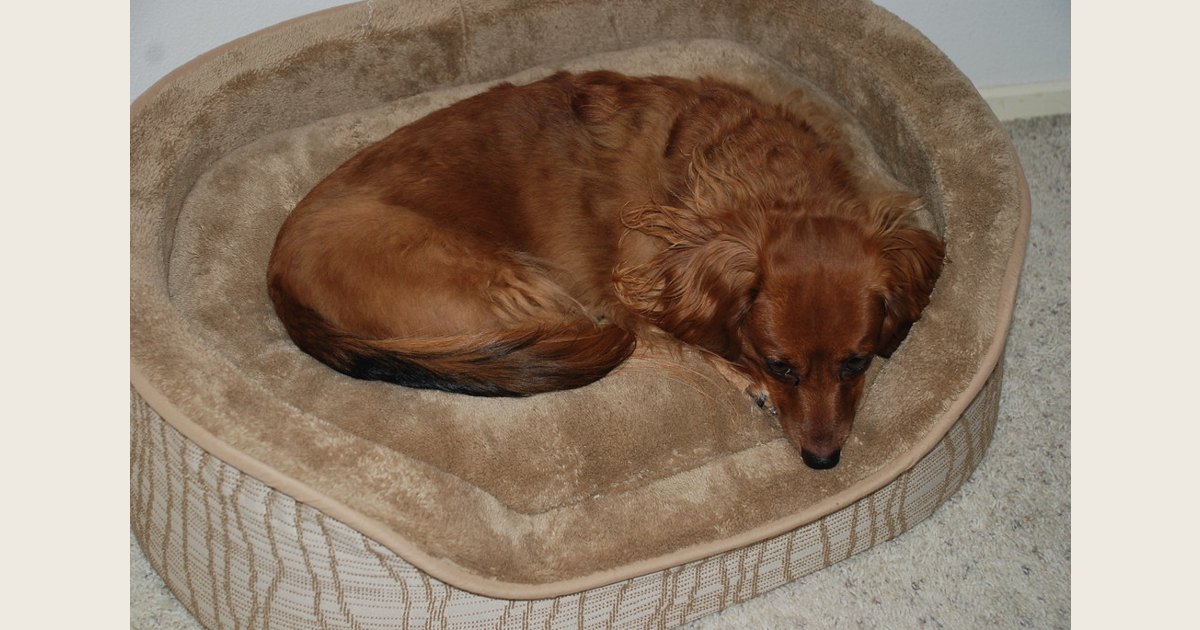
A bed may be too small if your dog can’t settle in their usual position without hanging off, pressing against a firm edge, or repeatedly shifting. Curling up alone doesn’t prove a poor fit; some dogs prefer to sleep curled.
Compare your dog’s natural resting positions with the bed’s usable surface—not its label. The American Kennel Club recommends enough space to stretch out, but no universal size chart fits every dog (AKC, “Choosing the Right Dog Bed for Your Dog”, updated March 4, 2026).
Featured image: “Molly the Dachshund Loves her Dog Bed” by Howard O. Young, Flickr, CC BY 2.0. Resized and padded illustrative stock; no product testing is implied.
Key Takeaways
- Look for whether your dog can comfortably curl up, turn around, and stretch into their usual positions—not just whether they fit while asleep.
- Measure the bed’s usable interior space, especially when bolsters, rounded sides, or a raised rim take up room.
- A dog avoiding a bed or shifting often doesn’t prove it’s too small; surface, temperature, location, access, and health can also affect how they settle.
- If a change in getting up, lying down, or resting seems uncomfortable, ask your veterinarian rather than treating it as a bed-size problem alone.
Signs your dog’s bed may be too small
The clearest clue is a mismatch between the sleeping space and the positions your dog naturally chooses. For example, your dog may try to stretch but consistently leave their head or paws over the edge, or their hips may hang off when they lie on their side. They might keep changing direction because the usable area doesn’t let them turn comfortably.
Treat these as observations, not a diagnosis. A dog curled neatly inside a small bed may be perfectly content if curling is their preferred posture and they can change position without being trapped by the sides. On the other hand, a dog may sleep partly on the floor because the bed surface is too warm, unfamiliar, lumpy, or placed somewhere they don’t like—not because it is too short.
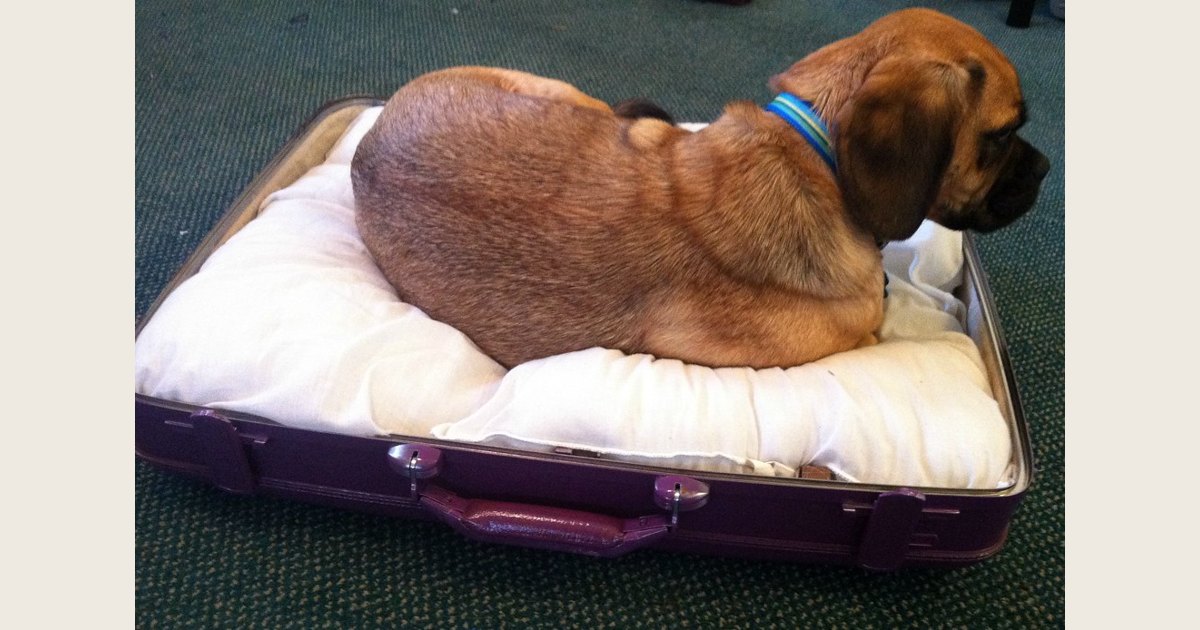
Pay attention to more than one nap. Note whether your dog lies curled, on their side, or fully stretched when they’re relaxed. A single position—especially a tight curl—isn’t enough to decide. If they choose a longer position on the floor or another surface but can’t fit that posture on the bed, that comparison is more useful than the product’s “small,” “large,” or weight-range label.
How to measure the fit
Use your dog’s relaxed sleeping footprint and the bed’s usable surface. This is a practical at-home comparison, not a standardized veterinary measurement or a promise that every dog needs a particular number of extra inches.
- Observe a natural stretch. When your dog is relaxed, note their longest and widest comfortable resting position. Include the head and paws if they commonly extend them, and watch for more than one nap if their posture varies.
- Mark the footprint. On a blanket or clear floor, use a soft tape measure or removable painter’s tape to estimate the rectangle they occupy in that stretched position. Don’t pull their legs straight or move them to make the measurement; use a position they choose on their own.
- Measure the sleepable area. Measure the flat inside surface where your dog can lie—not the bed’s outside edge or the full catalog dimensions. For a bolster bed, don’t count the space taken up by thick raised sides unless your dog actually rests on them comfortably. For a round bed, check the open diameter and shape of the center.
- Compare and test. See whether the measured area accommodates the positions you observed, with room for your dog to turn and settle. A little breathing room is useful, but no single add-on measurement works for every dog or design. If you’re shopping, compare the listed interior dimensions with your measurements and check what the manufacturer means by “size.”
A simple example: if the area your dog occupies when stretched is about 34 by 24 inches, a bed with only 29 by 20 inches of clear sleeping surface is unlikely to accommodate that full posture. Those numbers are just an illustration; they aren’t a universal sizing threshold. A different dog who usually curls into a compact position may use a smaller space comfortably, provided they can reposition and don’t appear constrained.
Why the label can be misleading
A bed’s advertised dimensions may describe its exterior, including fabric walls, bolsters, or a padded rim. That means two beds labeled “large” can offer different amounts of flat sleeping surface. Compare actual interior measurements, and look at a shape diagram or ask the maker what the dimensions include if the listing is unclear.
| Bed style | What to check | Possible fit issue |
|---|---|---|
| Flat mattress or pillow | Length and width of the cushion your dog can use | The outer cover may be larger than the padded sleep surface |
| Bolster or couch bed | Clear inside floor area between the raised sides | Bolsters can reduce the space available to stretch |
| Round or cuddler bed | Open center and whether your dog can change posture | A deep rim may suit curling but limit a long stretch |
| Elevated cot | Usable fabric platform and frame edges | The frame’s outside measurements may not equal the platform area |
Bed style matters as much as the label. The AKC notes that beds vary in shape and construction, including pillow, elevated, and covered options; the right style depends on how a dog rests and what features they need. A plush rim can be appealing to a dog who likes to lean their head, but it shouldn’t force their body into a cramped position. A firmer or orthopedic-style bed can still be too small if the usable surface is too short or narrow.
Is it too small—or is something else going on?
Before replacing a bed, check the reasons a dog might avoid it or keep moving. Put the bed on a stable, nonslip surface in a quieter spot and see whether your dog settles more easily. Check for lumpy or flattened padding, a noisy cover, heat, drafts, a strong new smell, or an edge they must step over. If the bed is new, let your dog approach it without forcing them to lie down.
| What you notice | What to check next |
|---|---|
| Your dog curls up but looks relaxed | See whether they can turn and stretch when they choose; curling alone doesn’t establish a size problem. |
| Head, paws, or hips hang over during a usual stretch | Compare that posture with the actual inside dimensions; test a larger sleepable area. |
| Your dog sleeps beside the bed | Try changing location or surface and check whether a high rim or slippery floor makes access awkward. |
| Your dog shifts or gets up repeatedly | Note when it happens and check comfort, temperature, noise, and posture; movement by itself doesn’t identify the cause. |
| Your dog has new trouble lying down or getting up | Contact your veterinarian. Don’t assume the bed is the only explanation. |
The AAHA Pain Management Guidelines for Dogs and Cats recommend assessing pain through behavioral, physical, and contextual indicators, rather than relying on one clue. If resting behavior changes along with stiffness, reluctance to move, or difficulty getting comfortable, a veterinarian can help assess what may be going on. The AAHA Senior Care Guidelines also emphasize that old age itself isn’t a disease and include environmental changes as part of senior care. A different bed may help with access or comfort, but it can’t diagnose or treat an underlying problem.
Keep the bed, adjust it, or replace it?
Keep the current bed if your dog settles comfortably, can use their normal sleeping positions, and isn’t consistently forced against the edge. If the fit seems close, first check that the bed is fully expanded after unpacking, reposition it, and remove anything that takes up usable room. Don’t cut, compress, or alter the bed in a way that could create loose filling, unstable edges, or chewing hazards.
Consider a larger bed when your dog’s usual stretched footprint exceeds the clear surface, their body routinely hangs off, or the raised sides leave too little interior space. Choose by interior dimensions and shape rather than breed name or weight alone. If a manufacturer provides only an exterior size or a broad weight band, treat that as a starting point and look for the usable measurements before deciding.
A style change may solve a different problem. A low-entry bed may be easier to step onto than a tall-sided one; a flat mattress may provide more open space than a similarly sized bolster bed. For a bed you already own, check the care label before washing the cover or cushion; our guide explains whether a dog bed can go in the washer. If cushioning is also a concern, see our guide to memory foam dog beds and how to choose one. A softer or more expensive bed isn’t automatically a better fit, and buying a new one won’t fix discomfort caused by a health issue.
Frequently asked questions
Is it okay if my dog sleeps with their head off the bed?
A relaxed head on a bolster or hanging slightly over an edge doesn’t alone prove the bed is too small. Check the fit if your dog can’t use another preferred position without much of their body hanging off.
My dog suddenly won’t use their bed. Should I buy a bigger one?
Not necessarily. Check the bed’s location, surface, temperature, and ease of access first. If avoidance comes with new difficulty lying down, getting up, or moving comfortably, contact your veterinarian.
The bottom line
Compare your dog’s usual resting positions with the bed’s clear sleeping surface, not its outside dimensions. If the fit seems comfortable, replacement may not be needed; new mobility or comfort changes warrant a veterinary conversation rather than assuming bed size is the cause.