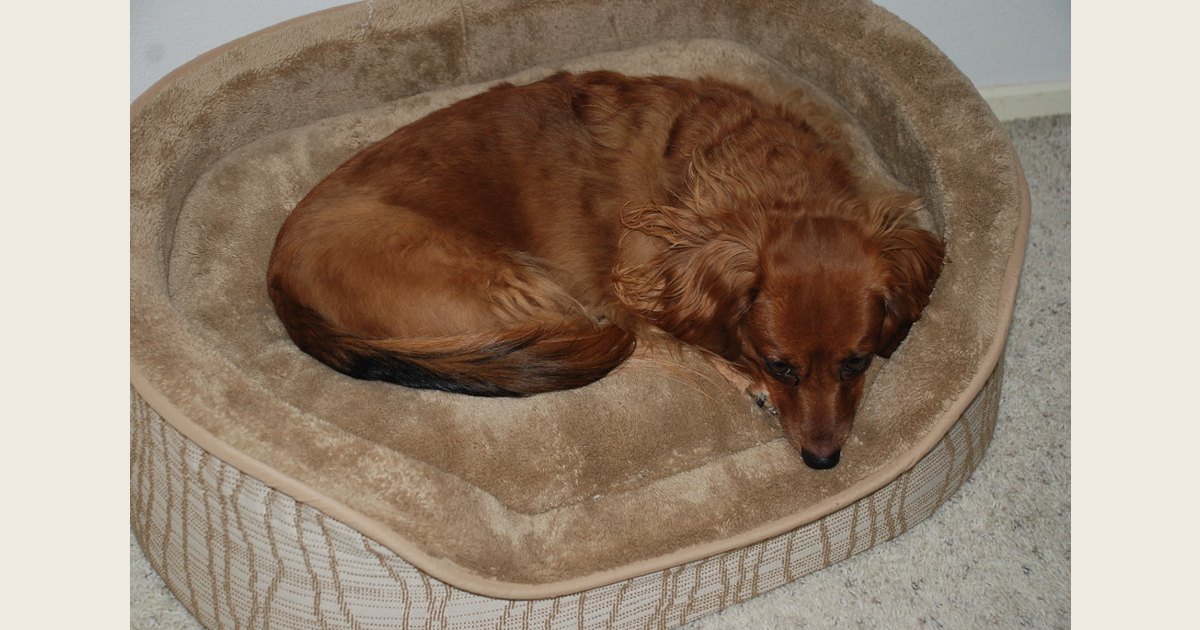
Photo: Molly the Dachshund Loves her Dog Bed by Howard O. Young, https://www.flickr.com/photos/16947083@N06/4245405188; https://creativecommons.org/licenses/by/2.0/. Resized and padded. Illustrative stock photo; no product testing is implied.
Yes—you can wash a dog bed in the washer only when that bed’s care label or manufacturer says you can. In many cases, the washable part is the removable fabric cover, not the foam, bolster, waterproof liner, or stuffed insert inside it. Start by separating the pieces, removing hair and solid debris, and following the directions for your exact bed on water temperature, cycle, detergent, and drying.
If there is no machine-wash instruction, do not treat the whole bed as washer-safe by default. Clean the cover or surface by the maker’s directions instead, and contact the manufacturer if the label is missing or unclear.
Quick takeaway: Think of a dog bed as several items, not one laundry load. Confirm what may be washed, clean only those components, and do not put the bed back together until every washable piece is completely dry.
Editorial note: Pet Gear Journal does not test or endorse the beds in this guide. The Casper references below illustrate one model’s component-specific manufacturer directions; general hygiene guidance is cited separately.
Why the answer depends on the bed
A dog bed can look like one cushion while being built from several materials with different care needs. For example, Casper’s Dog Bed has a removable cover around memory-foam and support-foam components. Casper specifically directs owners to wash the cover in cold water on a gentle cycle and tumble dry it on low—not to assume that every component shares those instructions. Casper’s product-care directions are a useful example of why the cover, foam, and bolsters should be treated as separate items.
Use this quick decision table before loading the washer:
| What you find | Safest next move |
|---|---|
| A removable cover with a machine-wash instruction | Wash the cover using its stated settings. Remove inserts first. |
| A foam, bolster, or stuffed insert with no wash instruction | Keep it out of the washer until the care label or manufacturer specifically permits washing it. |
| A care label that says the entire bed is machine washable | Follow that label exactly, and make sure the bed has room to move in the machine. |
| A non-removable bed with no machine-wash direction | Use the manufacturer’s hand-cleaning or spot-cleaning method rather than guessing. |
| No label, manual, or product-care page | Pause before washing. Ask the brand for instructions for that model. |
The Federal Trade Commission describes care labels as a way to provide regular-care instructions for covered textile goods and to use terms or symbols that accurately describe care procedures. That rule is not a universal promise that every pet bed is covered, but it reinforces the practical rule here: the item’s own care directions are more useful than a generic laundry setting. FTC Care Labeling Rule summary
Before you wash: do this 5-minute check
A little preparation keeps you from washing a part that was never meant to go in the machine.
- Locate the care instructions. Check the sewn tag first, then the product page, packaging, or support page. Look for separate directions for the cover, liner, foam, bolsters, and fill.
- Unzip and separate every removable piece. Set the pieces out in the order they came apart. That makes it easier to reassemble the bed later.
- Remove loose hair, dirt, and solids. Vacuum the bed or shake the cover outside before it goes into the washer. Pick up solid messes before laundering rather than rubbing them farther into the fabric.
- Check the washer’s capacity. The cover or approved bed should move freely in the drum. If it is crammed in, choose a larger machine or use the cleaning method on the care label.
- Close zippers and fasteners if the label allows. This helps keep loose edges from catching during the wash. If the label gives a different instruction, follow it instead.
Photo: Upcycled Dog Bed by Hey Paul Studios, https://www.flickr.com/photos/45257015@N03/6495139857; https://creativecommons.org/licenses/by/2.0/. Resized and padded. Illustrative stock photo; no product testing is implied.
How to wash a dog-bed cover in the washer
1. Treat stains before the regular wash—only as directed
If there is a muddy patch or a spot that needs extra attention, use the stain-treatment approach allowed by the bed maker and the cleaner’s label. Do not use a cleaner merely because it works on another fabric or another dog bed.
Product instructions can be quite specific. For its own Dog Bed, Casper says an enzyme-based spot cleaner may be used for tough stains. That is a product-specific example, not a blanket instruction for all materials or all pet stains. Casper’s care instructions
2. Wash only the approved component
Put the cover—or the entire bed only if its label explicitly permits it—into the washer. Use the water temperature and cycle on the label. This is the point where generic advice can cause trouble: a setting that is fine for one bed may not be the setting specified for another.
For a concrete example, Casper says to wash its removable cover in cold water on a gentle cycle. That is the right setting for that product’s cover; it is not a substitute for reading a different bed’s label. Casper Dog Bed materials and care
3. Use the detergent and add-ons the instructions allow
Measure detergent according to the product and washer directions. Avoid adding boosters, fragrances, fabric softeners, or other laundry products unless the bed’s care guidance permits them. A simpler load makes it easier to identify what caused a problem if the cover comes out stiff, scented, or still soapy.
If you accidentally use more detergent than intended or see visible suds after the wash, rinse the washable cover again before it goes back on the bed. Do not reassemble the bed while cleaner remains on the fabric.
4. Dry by the label—not by habit
Drying instructions matter just as much as wash instructions. A cover that can be machine washed may still have a specific dryer setting, while another cover may require air drying. Follow the method and heat setting stated for that component.
Casper’s directions for its cover are to tumble dry on low. If your bed’s label says air dry, no heat, or gives another method, that direction takes priority. Casper Dog Bed care instructions
Before reinstalling a cover, check the seams, zipper area, corners, and thickest parts of any insert you cleaned. They should feel dry, not cool or damp. Give components more drying time when needed; closing a damp insert inside a cover makes it harder to tell whether moisture remains.
What about foam inserts, bolsters, and non-removable beds?
This is where a cautious approach matters most. Do not assume that a foam insert is washer-safe just because its cover is. Casper’s product page distinguishes the removable cover from the two-layer foam construction and gives the washing directions specifically for the cover. Casper Dog Bed product page
For any insert, bolster, liner, or fill:
- Use a washer only when the instructions specifically approve that piece. “Machine-washable cover” does not automatically mean “machine-washable bed.”
- If directions call for surface cleaning or hand cleaning, follow that method. Keep the component separate from the washable cover.
- If the insert gets wet during the approved cleaning method, give it enough time to dry all the way through. Check the center and thick edges rather than judging only the outside fabric.
- If the bed is too bulky for your washer, do not force it into the drum. Use the maker’s alternate care method or a machine with adequate space.
For a non-removable bed, the question is simpler: only machine wash it when the tag or manufacturer clearly says the complete bed can be machine washed. Otherwise, use the stated hand-cleaning or spot-cleaning route. If the only directions say “wipe clean,” do not reinterpret that as permission to soak or machine wash it.
Water temperature, dryer heat, and deodorizing: what to choose
There is no single “best” washer setting for every dog bed. The best setting is the one tied to the material and construction in front of you.
| Care question | Practical rule |
|---|---|
| Cold, warm, or hot water? | Use the temperature on the care label. Do not select a hotter wash just because another bed recommends it. |
| Normal or gentle cycle? | Use the stated cycle. If the label says gentle, treat that as part of the product’s care instructions, not an optional suggestion. |
| Can I put it in the dryer? | Only if the component’s instructions permit dryer use. Follow the listed heat setting. |
| Can I deodorize it with household add-ons? | Use only products and methods the bed maker and cleaner labels allow. Do not turn an unknown fabric or liner into a DIY experiment. |
| How often should I wash it? | Clean when it is dirty, smelly, contaminated, or needs routine upkeep, while following the product’s specific care guidance. There is no one schedule that fits every bed and household. |
Household factors can affect how often a washable cover needs attention. PetMD notes that a dog’s activity level, shedding, time outdoors, and allergies can influence washing frequency. Treat those factors as a cue to inspect the bed and use its care instructions—not as permission to machine wash a component the manufacturer has not approved. PetMD’s guide to washing a dog bed
A manufacturer’s general cleaning article may offer broad suggestions, but the actual product page is more useful when it gives a component-level instruction. Casper’s general guide itself tells readers to double-check whether a removable cover can be machine washed, while its Dog Bed product page supplies the specific cold, gentle, low-dry directions for that model. Casper’s washing guide Casper’s Dog Bed care page
Troubleshooting common problems
| Problem | What to do next |
|---|---|
| The load is thumping or the bed cannot move in the washer | Stop the cycle if you can do so safely. Use a larger-capacity machine or the alternate cleaning method in the care directions. |
| You washed the cover but the odor remains | Check whether an insert, liner, or trapped debris is the source. Clean only the part the manufacturer says may be cleaned. |
| The cover is clean but the inside feels damp | Leave the bed disassembled and continue drying. Check the thickest areas before putting it back together. |
| You cannot find instructions for the foam or filling | Do not machine wash it on a guess. Contact the manufacturer with the model name or use its stated surface-care method. |
| The cover has visible detergent residue | Rinse the washable cover again, then dry it by the label before reinstalling. |
The bottom line
You can wash a dog bed in the washer when the care label or manufacturer explicitly allows it. In practice, that often means washing a removable cover while keeping foam, bolsters, liners, and stuffing out of the machine unless they have their own approval. Remove hair and debris first, use the exact wash and dry settings for the approved component, and reassemble the bed only after it is fully dry.
When in doubt, protect the bed rather than gamble on a cycle: a missing label or unclear instruction is a reason to ask the brand, not a reason to assume the washer is safe.